Showing posts with label Treatments. Show all posts

Friday, May 23, 2014


These lined window treatments with unique bursts of color are a great way to transform your windows. The engineered embroidered and printed flowers offer dimension mixed with complementary hues for a visually exciting look.


Bring depth and dimension to your windows with these beautifully designed window treatments. The color blocked sections in complementary colors are accentuated by engineered pleating in a wavy design


The luxurious look of these window treatments give your room a refined feel. Solid colored panels and charcoal and cream leaf silhouettes on the valance are heightened by silver and gold accents.


The deep gold and light cream colors of this window treatment will add a touch of elegance to either classic or contemporary decors.


These refreshing window treatments feature a unique medallion design with a mixture of embroidery and textured jacquard in soothing shades of brown, taupe and gold.


This elegant window panel has a faux silk finish and is adorned with embroidered flowers for a touch of subtle grace. A great way to bring sophistication to your windows.


Regal and royal these window panels really make a statement. The panels and ascot valances feature metallic scrolling patterns that give them a subtle shimmer, adding drama to your decor. Merlot, gold, chocolate and cream colors all feature a golden metallic accent.


Window panels are a lovely addition to any window with corner weights sewn in for elegant drapability. The generous width gives a rich, full look to windows, while the classic styling enhances both formal and casual settings. Panels are also interlined for heat and cold insulation as well as for room darkening capabilities.


Window treatments have sweet rosettes along the top to bring a lovely touch to any window. Pair with the Rosette sheer window panels for a stunning look.


Add a natural, rugged appeal to your windows with these textured window treatments. The tightly woven panel and valance adds character to your decor and is a great coordinate in any room.

Wednesday, May 14, 2014

You can find ideas for elegant curtains and drapes to enhance your  Bedroom decor , I hope you like it . Enjoy !
 .


Banded Silk Panels 

In a quietly neutral master bedroom, these fixed, banded drapery panels eschew the standard ring-and-rod installation in favor of an innovative combination of grommets and wall-mount hooks. The treatment adds dimension and soft draping to the silk panels, and the flat braid above and below the wide gray band contributes a polished finish, with lined panels that puddle slightly. Because the panels are fixed, natural woven shades do the practical work, discreetly controlling privacy and light.


Formal Silk Drapes 

High ceilings give a space grandeur, but they also can make a room feel uncomfortably cavernous. To give the room more human-scale proportions, add crown molding and painted bands. Here, gold stripes and buttons accent the bands. Formal silk draperies with tightly smocked headers hang on gilded rods at window frame-level.


Valance and Drapery Panels 

A pretty, detailed window treatment adds a special welcome to a guest room. For a bedroom with an old-fashioned feel, a scalloped valance overlies drapery panels sewn from a novelty print with a green background.
The valance and drapery panels attach by rings to an iron rod featuring decorative finials. Greek-key trim stitched to the edges of the panels is an appropriate finishing touch that echoes the classical motifs of the fabric. Tasseled rope tiebacks gently hold the panels in place, creating a soft fullness that works with the romantic feel of the inviting room. Framed art flanks the window, completing the setting.


Bedroom Curtains in a Soft, Soothing Hue

The secret to an inviting guest room is a comfy bed, of course, but ambience matters, too. For a restful retreat, use a soft color throughout and include only one or two bold standouts in the decor. Here, soft green for pleated draperies, walls, furniture, and bedding wraps the room with serenity.


White Drapery Panels

In a bedroom where toile sets the romantic scene, creamy white drapery panels edged in a flat braid enhance the color palette. The goblet-header drapery panels, sewn to white rings, slide easily on the painted white drapery rod. The exposed rod is often a fresher look than a fabric-covered rod or cornice. Simple touches, such as the flat braid, give a neatly finished look to drapery panels. Wood blinds behind the drapery are virtually invisible when pulled up, but block out the light when needed


Curtains with Complimentary Pattern

Fun rooms call for lighthearted walls and window treatments. In a home of classic good taste, this boys' room features a playful interpretation of traditional blue: horizontally striped painted wall finish and drapery panels fabricated from an inventive leaf-print fabric. The panels hang by fabric ties from the exposed rod—a treatment that won't be outgrown too quickly. The folded-fabric border is snappy, elevating a standard treatment into a classic accompaniment suitable for any age.


Iron Curtain Rings

Getting the latest look has never been easier, thanks to innovative products in today's market. In this case, purchased curtain panels are accessorized with iron curtain rings that simply clip to the top of the curtain.


Contemporary Wool Curtains

A contemporary twist on classic American patchwork, wool fabric softens the modern style of a city bedroom. The operable panels—banded in off-white and sewn to chrome rings—slide easily on the unadorned chrome rod. The subtle difference between shades of gray and taupe wool play off the rich brown walls, the neatly tied linen headboard and the white bed linens. The chrome rod echoes that finish on the stylized floor lamp, while three narrow blinds meet the need for privacy.


Toile Curtains

With a slanted ceiling and one window, this 8x13-foot petite guest room in a seaside cottage posed more challenge than charm. To downplay its small size and odd shape, a simple toile pattern featuring seashells was wrapped around the walls and window. Indeed, homeowners hesitant to use a single pattern over and over should consider toile—it's one of the easiest patterns to master with success.

 
Full-length Drapery Panels

Older homes often feature casement windows along the upper section of walls. To lengthen these windows and provide a colorful backdrop to the beds, full-length cotton drapery panels hang over the windows and extend around the corner to the other walls in the room.


Tailored Drapes 

Drapery panels introduce subtle pattern and color in this master bedroom without overwhelming fabrication. Lined and interlined for warmth and graceful posture, the panels graze the neutral carpet; they are sewn rings for a traditional operable treatment
.

Striped Silk Curtains 

A stunning silk stripe unifies a guest room, appearing in the high-style window treatment and in the lining for the tie-on bed hangings. To dress the stately French windows, the silk stripe is fabricated into gathered balloon shades; it also hangs as side panels. The shapely finial and decorative rings contribute detailing to the effect. Silk fabric works equally well as the lining for the panels that define iron twin beds. Along with the Aubusson rug and oil portraits, classic fabrications ground the room in a feeling of continental luxury.

Monday, February 3, 2014

Pick the right treatments for your windows. Get to know the available options  valances, shades, panels and more  and how to best use each treatment with these easy tips

Valances 


 A valance is a little bit of fabric that does a big job. It hangs across the top of a window, adding softness, color, and pattern to a hard architectural element. Purely decorative, a valance helps establish a room's style. At its most basic, a slip of fabric can be attached to a rod with clip rings. For more detail, add pinch pleats.

Simple Valances 


The simple valance is a casual treatment that works well for family areas such as the kitchen, breakfast room, and bathroom. In rooms where privacy isn't an issue, the valance can hang alone. When privacy is a concern, the valance easily pairs with a hard treatment, such as a blind, shade, or shutters.

Box-Pleated Valances 


Those who appreciate a classic decorating style will fall in love with the box-pleated valance. This tailored treatment is a natural in rooms where you want a formal air, such as a living room, dining room, or master bedroom. The stationary treatment's crisp stitched pleats lie flat against a mounting board, which is typically attached to the wall with simple L-shape brackets.

The box-pleated design is easily duplicated on furnishings such as table coverings, slipcovers, or bed skirts to unify a room. Here, fabric-covered buttons accent the corner pleats on the table topper to mimic the valance.

Simple Swags 


Sometimes a simply knotted scarf worn around the neck is the perfect accent for an outfit. A simple swag on a window dresses up a room the same way. A loosely slung fabric strip, unlined or lined, draped over a decorative rod or wound over a tieback at each top corner of a window frame can add an abundance of style. The middle of the fabric strip acts as a valance; the ends, whether cut into opposing diagonals or simply hemmed, softly hang down the sides of the window.

Swags can be made of luxurious fabrics to fit formal decor or dressed down in cottons befitting a cottage or country home. The beauty of this style is its simplicity, so it's most appropriate used alone on windows where privacy is not an issue.

Balloon Shades 


For the ultimate romantic gesture, nothing beats a billowy balloon shade. This sumptuous fabric shade features cascading scallops that culminate in graceful, blousy folds along the bottom. Cords strung though rings on the back make the shade movable, and as the treatment is raised, the vertical gathers create dramatic poufs. Because this treatment usually remains raised, it acts as a valance more often than a shade. The amount of fabric used--at least twice the width of the window--creates the opulent look. Large designs can get lost in the multiple gathers, so opt for solid-color or small-pattern fabrics. Be aware, too, that the number of gathers, pleats, or scallops creates different looks within the balloon-shade and valance family. An Austrian shade, for example, has less shirring and is therefore more tailored than its cousin, the balloon shade. Because this window treatment is so showy, use it in small doses.

Tie-Up Shade 


Simplicity is the name of the game with tie-up shades. Sometimes called a stagecoach-style shade, this economical treatment uses fabric in its most unconstructured form: It hangs flat from a rod or mounting board, then the bottom edge is hand-rolled or folded to the desired position. Fabric ties, ribbons, or cords hold the rolls or folds in place. Adjusting the shade requires untying and rerolling it by hand, making this treatment more decorative than functional. Consider using it where you're likely to leave the shade down to hide an unsightly view or open in a room where privacy or sunlight aren't issues.

Roman Shades 


For the look of luxury without yards of flowing fabric, a Roman shade is a wise choice. When closed, the shade is a flat fabric panel. When raised, cascades of deep, horizontal folds are responsible for the tidy look. Cords strung through rings on the back of the fabric give the shade its mobility. Some Roman shades are made without dowels or lining, resulting in looser, puffier folds.

Roman Shade Tips 


A Roman shade can be mounted inside or outside a window frame. Though the shade is often used alone, it can be the practical layer combined with side panels or a valance. Appropriate almost anywhere, a Roman shade's level of formality is defined by fabric and trim choices. You could use plain muslin in a sunroom or toile in a master bedroom. Just be sure to choose fabric that can form handsome folds.

Cornices 


Think of a cornice as a wood valance, it is typically made from plywood, assembled with wood screws and corner brackets, then painted or covered with wallpaper or fabric and mounted to the wall above a window. Like a valance, a cornice can appear alone or team with another treatment. Because it is usually made of wood, a cornice benefits from being paired with a soft treatment, such as a curtain or fabric shade, to temper its hard lines. These structural lines are especially effective in rooms that lack interesting architecture. They can camouflage a window's wimpy trim or bring interest to a room that doesn't have crown moldings.

Rod-Pocket Panels 


Of the many ways to attach a drapery panel to a rod, few match the ease of the rod pocket. In this treatment, the curtain rod simply slips through a channel sewn into the panel's top edge. The tighter the fit, the more dramatic the shirring. For a ruffled header, sew a pocket a few inches down from the top edge; when the rod is pushed through, the fabric above it fans out to form a ruffle.

Rod Pocket Panels 


Rod-pocket panels are commonly made of lightweight fabrics and left unlined for a casual look. But don't overlook this style for more formal decor. For a sumptuous style statement, consider plush velvet panels shirred tightly on a substantial rod. Because panels don't slide easily on a rod, especially when tightly gathered, they're typically used in the closed position or held open with decorative tiebacks.

Panels with Rings 


Prickly metal hooks used to be standard fare for hanging draperies. Stuck into the back of a panel, the hardware was out of sight and out of mind. No more. Wood or metal rings that slide along a pole allow you to put hardware in a starring role, complementing virtually any style of drapery. Besides being fashionable, panels with rings are easy to open and close and offer an alternative to anyone who dislikes the cord-and-pulley system of traverse rods.

Tips for Using Panels with Rings 


Think of rings, rods, brackets, and finials as a drapery's jewelry. Hardware with unusual shapes, eye catching colors, or high contrast will draw the eye up, focusing attention on the top of the panels, window, and ceiling. Large rings can be hand-tacked along a panel's top edge; small clip on rings are fine for suspending lightweight fabrics. Some rings open and can slip through buttonholes or grommets at the top of the panel.


Pleated Panels 


In the world of window treatments, pleated drapery panels are the classics. They withstand the whims of window fashion, adding elegance and sophistication to any room. There are several styles of pleats, all of which are sewn into a panel's top edge to create a decorative header. Pleats are often formed with the help of header tape, which is available by the yard at fabrics stores. Sewn to the panel's back, the tape forms pleats when pulled. Hooks are then inserted into the tape and hung on rings, or more typically traverse rods, which have a cord-and-pulley system for opening and closing the panels.

Pleat Styles 


The most common pleat, the pinch pleat is a series of equally spaced single, double, or triple pleats that are pinched in the center, forming fans above and below the pinch.
A goblet pleat is similar to a triple-pinch pleat, except the pleating above the pinch is exaggerated with a stiffening card or paper to form a wineglass silhouette.
Pencil pleats are narrow single pleats formed in neat, tight folds.
Cartridge pleats are also single pleats, but they are spaced more widely and the tops rounded.

Tab-Top Panels 


The unpretentious look of tab-top panels makes them a natural for country and cottage decorating. There are many variations, but standard tabs are simply loops of fabric sewn into or onto the valance's top seam. The panel hangs relatively flat from these tabs, providing a good opportunity to showcase interesting fabric prints. 
Because the curtain rod is visible between the tabs, you can add decorative rods and finials for more impact. To maintain the fuss free feel this style evokes, use cotton or linen fabrics in simple checks, stripes, plaids, or florals. These are usually stationary panels, because drawing them across the rod can be cumbersome.
By : Sarah Egge 

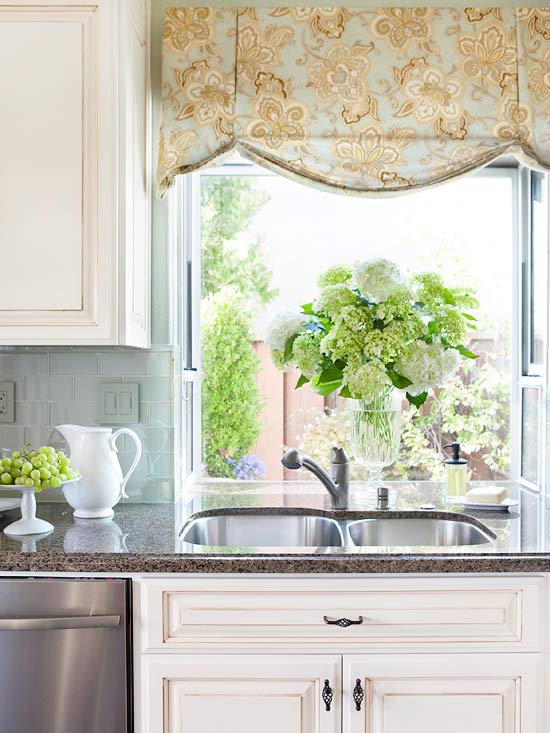
 In a room as functional as a kitchen, which is packed with metal appliances and wood cabinets, window treatments might be the only source of softness and embellishment in the entire space. Here are the four things you need to consider when choosing kitchen window treatments.

Window treatments bring the pretty. In spaces outside the work core, such as breakfast nooks, none are better at this task than floor-length curtain panels, which offer big doses of color and pattern when they flank a large bay window or set of sliding doors. On a smaller scale, a swag of floral chintz draped over a single window can also make a bright statement. Roman and roller shades reveal texture and pattern when they are lowered, and stationary valances and cornices are like accent marks over windows you want to draw attention to. For the most decorative effect, choose fabrics that have eye-catching hues and designs, and have fun with trims, tassels, fringe, or bold banding to give the treatment a finished look.

You might be tempted to forgo window treatments in your kitchen until you realize the neighbors can see straight into your breakfast nook. When you?re reading the Sunday paper wearing your favorite fluffy robe, this might be a problem. For temporary privacy issues, which occur only when you?re feeling shy in your PJs, consider quick-draw curtains, or blinds and shutters, which close at the tilt of a wand. For consistent privacy needs, look for screening materials that let you see out and allow some daylight to pass yet block views in; try cellular shades and roller shades made from translucent or woven materials, or try sheer fabric curtain panels. However, perform a quick check before choosing: Turn on the lights in the kitchen one night, then run across the street and see what you can see through the windows with the blinds or curtains drawn.

Get inspired by this 2014 Kitchen Window Treatments Ideas from BHG . I hope that you will like and find it useful for you ... Enjoy it !!


Sunday, February 2, 2014

Clever Ways to Personalize Window Treatments :  Ready made curtains, blinds, shades, and tablecloths are just the starting point for these stylish window treatments.

Get inspired by this 2014 Window Treatments update Ideas from BHG . I hope that you will like and find it useful for you ... Enjoy it !!


Add Texture with Burlap 

Add texture to a living room by adding a burlap valance to window treatments. The oat-color burlap also grounds a bold patterned curtain panel.

How to Make It: Sew or use fabric glue to attach decorative trim to the raw edge of the burlap. Use curtain clips to hang burlap valance and curtain panels.


Use Sheers to Lighten Up 

Dark color curtains are great for privacy, but they can also darken a room. Add style and light at the same time by adding a band of sheer fabric across the top of plain panels.

How to Make It: Cut across the panel about 1 inch below the top edge. Sew a sheer piece to the 1 inch strip and then reattach the original panel to the bottom of the sheer (shorten the panel as needed to fit your window before sewing the raw edge to the sheer fabric). Use fusible web or fabric glue to apply decorative ribbon over the seams. Tack sheer ribbons to the back of the 1-inch strip and then tie them loosely over the rod.


Add Pretty Details 

Add fun flair to a plain window shade with a pretty rosette.

How to Make It: Cut a 4 1/2x48-inch strip of patterned fabric that matches your bedroom decor. Press the strip in half lengthwise, wrong sides facing, and coil the strip into a rosette shape. Hand stitch the rosette to a circle of interfacing. Top-stitch through the center of the rosette and trim away excess interfacing. Pin rosette to the curtain.


Add Elegance with Stripes 

Dress up plain curtain panels by adding elegant stripes. Light blue linen curtain panels add color and texture to a plain cream color window treatment.

How to Make It: Cut 8 inch wide strips from ready-made linen curtain panels for each curtain. Create frayed edges by carefully pulling threads from the fabric along the sides and bottom. Place the 8 inch strips over the top of the plain panels. Stitch along the base of the rod pocket and lightly tack the tops of the rod pockets together.


Add Grommets 

Give pretty panels a modern touch with grommets.

How to Make It: Buy grommets (sold in sets of 10) and follow the instructions on the package. To install, cut a small hole in the fabric, insert both pieces of the grommet, and use the tool that comes in the kit to press them together.


Top It Off 

Punch up plain panels with a valance made of decorative napkins.

How to Make It: Cut square napkins diagonally to create triangles. Fold the cut ends under and stitch them to the panel's top edge. Cut more napkins into strips and gather into a ruffle, which you can stitch along the bottom of the panel and the tieback.


Modern Take on Lace 

Update your favorite lace panels by inserting a horizontal band of patterned fabric. This block of fabric adds a modern edge and also gives privacy.

How to Make It: Cut across the panel about 6 inches below the top edge. Sew the patterned fabric piece to the top panel and then attach the original lace panel to the bottom of the fabric piece (shorten the panel as needed to fit your window before sewing the raw edge to the fabric). Use fusible web or fabric glue to apply decorative ribbon over the seams.


Tied with a Bow 

Give plain draperies a sweet makeover with pretty ribbon bows and coordinating stripes.

How to Make It: Create simple two-toned bows from coordinating ribbons. Attach bows to each pleat at the top of the panel. Use fusible web or fabric glue to apply decorative ribbon to the bottom of each panel.


Add a Border 

Dress up plain curtain panels with decorative fringe found at a crafts store. Choose trim in the same color as the panel for subtle drama.

How to Make It: Measure the width of the curtain panel and cut six sections of fringe in the measured width plus one inch. (The extra 1 inch allows for 1/2 inch of trim on each side to tack behind the panel to hide the raw edge.) Starting at the bottom of the panel, measure one inch from the hem and stitch on a row of trim. Continue with the next two rows. Stitch fringe onto panel leaving one inch between the top and bottom of each row.


Paint On Style 

Add artistic flair to a plain curtain panel with stencils and fabric paint.

How to Make It: Lay the curtain panel flat on top of several sheets of scrap paper as a blotter under the area being stenciled. Cover the back of a stencil with spray adhesive and then press it on the panel. Using fabric paint and a stencil brush, cover the design with a pouncing motion. Remove the stencil. When the paint is dry, repeat the process to create the desired pattern.


Pretty Painted-On Flowers 

Add a fresh theme to a plain curtain panel with a floral design stencil.

How to Make It: Lay the panel flat on top of scrap paper. Cover the back of a stencil with spray adhesive and then press it on the panel. Using fabric paint and a stencil brush, apply paint directly onto the curtain with a pouncing motion. Remove the stencil. When dry, repeat the process as desired.


Add Style to a Roman Shade 

Add style to a window with multiple treatments. A Roman shade and curtain panels work well together. Customize a plain Roman shade with a stenciled design in a color that coordinates with the curtain panels.

How to Make It: Lay the panel flat on top of scrap paper. Cover the back of a stencil with spray adhesive and then press it on the panel. Using fabric paint and a stencil brush, apply paint directly onto the curtain with a pouncing motion. Remove the stencil. When the paint is dry, repeat the process as desired. Hang Roman shade and curtain panels.


Rethink Cloth Napkins 

Turn patterned cloth napkins into cafe curtains by joining their edges with jean rivets and grommets. You get a pretty window treatment with no sewing.

How to Make It: Purchase a rivet and grommet kit from a fabric store. Join the edges of two napkins together with jeans rivets spaced every 2 inches. To install, cut a small hole in the fabric, insert both pieces of the rivet or grommet, and use the tool that comes in the kit to press them together. Repeat until all napkins are attached and the panel is wide enough to cover your window. Add the large grommets along the tops of the panels and thread onto a curtain rod.


Pillowcase Turned Shade 

Create a colorful window treatment from pillowcase and ribbon. 

How to Make It: To make a shade from a pillowcase, remove the seams and press flat. Cut the case to size and fuse the hems. Fuse ribbon down the center of the shade. Look for fusible products that are washable.