Pick the right treatments for your windows. Get to know the available options valances, shades, panels and more and how to best use each treatment with these easy tips
Valances
A valance is a little bit of fabric that does a big job. It hangs across the top of a window, adding softness, color, and pattern to a hard architectural element. Purely decorative, a valance helps establish a room's style. At its most basic, a slip of fabric can be attached to a rod with clip rings. For more detail, add pinch pleats.
Simple Valances
The simple valance is a casual treatment that works well for family areas such as the kitchen, breakfast room, and bathroom. In rooms where privacy isn't an issue, the valance can hang alone. When privacy is a concern, the valance easily pairs with a hard treatment, such as a blind, shade, or shutters.
Box-Pleated Valances
Those who appreciate a classic decorating style will fall in love with the box-pleated valance. This tailored treatment is a natural in rooms where you want a formal air, such as a living room, dining room, or master bedroom. The stationary treatment's crisp stitched pleats lie flat against a mounting board, which is typically attached to the wall with simple L-shape brackets.
The box-pleated design is easily duplicated on furnishings such as table coverings, slipcovers, or bed skirts to unify a room. Here, fabric-covered buttons accent the corner pleats on the table topper to mimic the valance.
Simple Swags
Sometimes a simply knotted scarf worn around the neck is the perfect accent for an outfit. A simple swag on a window dresses up a room the same way. A loosely slung fabric strip, unlined or lined, draped over a decorative rod or wound over a tieback at each top corner of a window frame can add an abundance of style. The middle of the fabric strip acts as a valance; the ends, whether cut into opposing diagonals or simply hemmed, softly hang down the sides of the window.
Swags can be made of luxurious fabrics to fit formal decor or dressed down in cottons befitting a cottage or country home. The beauty of this style is its simplicity, so it's most appropriate used alone on windows where privacy is not an issue.
Balloon Shades
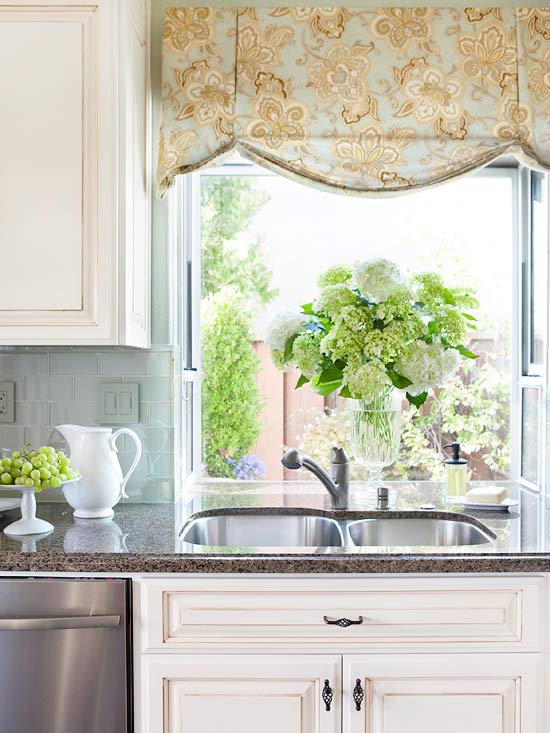
For the ultimate romantic gesture, nothing beats a billowy balloon shade. This sumptuous fabric shade features cascading scallops that culminate in graceful, blousy folds along the bottom. Cords strung though rings on the back make the shade movable, and as the treatment is raised, the vertical gathers create dramatic poufs. Because this treatment usually remains raised, it acts as a valance more often than a shade. The amount of fabric used--at least twice the width of the window--creates the opulent look. Large designs can get lost in the multiple gathers, so opt for solid-color or small-pattern fabrics. Be aware, too, that the number of gathers, pleats, or scallops creates different looks within the balloon-shade and valance family. An Austrian shade, for example, has less shirring and is therefore more tailored than its cousin, the balloon shade. Because this window treatment is so showy, use it in small doses.
Tie-Up Shade
Simplicity is the name of the game with tie-up shades. Sometimes called a stagecoach-style shade, this economical treatment uses fabric in its most unconstructured form: It hangs flat from a rod or mounting board, then the bottom edge is hand-rolled or folded to the desired position. Fabric ties, ribbons, or cords hold the rolls or folds in place. Adjusting the shade requires untying and rerolling it by hand, making this treatment more decorative than functional. Consider using it where you're likely to leave the shade down to hide an unsightly view or open in a room where privacy or sunlight aren't issues.
Roman Shades
For the look of luxury without yards of flowing fabric, a Roman shade is a wise choice. When closed, the shade is a flat fabric panel. When raised, cascades of deep, horizontal folds are responsible for the tidy look. Cords strung through rings on the back of the fabric give the shade its mobility. Some Roman shades are made without dowels or lining, resulting in looser, puffier folds.
Roman Shade Tips
A Roman shade can be mounted inside or outside a window frame. Though the shade is often used alone, it can be the practical layer combined with side panels or a valance. Appropriate almost anywhere, a Roman shade's level of formality is defined by fabric and trim choices. You could use plain muslin in a sunroom or toile in a master bedroom. Just be sure to choose fabric that can form handsome folds.
Cornices
Think of a cornice as a wood valance, it is typically made from plywood, assembled with wood screws and corner brackets, then painted or covered with wallpaper or fabric and mounted to the wall above a window. Like a valance, a cornice can appear alone or team with another treatment. Because it is usually made of wood, a cornice benefits from being paired with a soft treatment, such as a curtain or fabric shade, to temper its hard lines. These structural lines are especially effective in rooms that lack interesting architecture. They can camouflage a window's wimpy trim or bring interest to a room that doesn't have crown moldings.
Rod-Pocket Panels
Of the many ways to attach a drapery panel to a rod, few match the ease of the rod pocket. In this treatment, the curtain rod simply slips through a channel sewn into the panel's top edge. The tighter the fit, the more dramatic the shirring. For a ruffled header, sew a pocket a few inches down from the top edge; when the rod is pushed through, the fabric above it fans out to form a ruffle.
Rod Pocket Panels
Rod-pocket panels are commonly made of lightweight fabrics and left unlined for a casual look. But don't overlook this style for more formal decor. For a sumptuous style statement, consider plush velvet panels shirred tightly on a substantial rod. Because panels don't slide easily on a rod, especially when tightly gathered, they're typically used in the closed position or held open with decorative tiebacks.
Panels with Rings
Prickly metal hooks used to be standard fare for hanging draperies. Stuck into the back of a panel, the hardware was out of sight and out of mind. No more. Wood or metal rings that slide along a pole allow you to put hardware in a starring role, complementing virtually any style of drapery. Besides being fashionable, panels with rings are easy to open and close and offer an alternative to anyone who dislikes the cord-and-pulley system of traverse rods.
Tips for Using Panels with Rings
Think of rings, rods, brackets, and finials as a drapery's jewelry. Hardware with unusual shapes, eye catching colors, or high contrast will draw the eye up, focusing attention on the top of the panels, window, and ceiling. Large rings can be hand-tacked along a panel's top edge; small clip on rings are fine for suspending lightweight fabrics. Some rings open and can slip through buttonholes or grommets at the top of the panel.
Pleated Panels
In the world of window treatments, pleated drapery panels are the classics. They withstand the whims of window fashion, adding elegance and sophistication to any room. There are several styles of pleats, all of which are sewn into a panel's top edge to create a decorative header. Pleats are often formed with the help of header tape, which is available by the yard at fabrics stores. Sewn to the panel's back, the tape forms pleats when pulled. Hooks are then inserted into the tape and hung on rings, or more typically traverse rods, which have a cord-and-pulley system for opening and closing the panels.
Pleat Styles
The most common pleat, the pinch pleat is a series of equally spaced single, double, or triple pleats that are pinched in the center, forming fans above and below the pinch.
A goblet pleat is similar to a triple-pinch pleat, except the pleating above the pinch is exaggerated with a stiffening card or paper to form a wineglass silhouette.
Pencil pleats are narrow single pleats formed in neat, tight folds.
Cartridge pleats are also single pleats, but they are spaced more widely and the tops rounded.
Tab-Top Panels
The unpretentious look of tab-top panels makes them a natural for country and cottage decorating. There are many variations, but standard tabs are simply loops of fabric sewn into or onto the valance's top seam. The panel hangs relatively flat from these tabs, providing a good opportunity to showcase interesting fabric prints.
Because the curtain rod is visible between the tabs, you can add decorative rods and finials for more impact. To maintain the fuss free feel this style evokes, use cotton or linen fabrics in simple checks, stripes, plaids, or florals. These are usually stationary panels, because drawing them across the rod can be cumbersome.




.jpg)
